December 12, 2025
Investment climate of the Republic of Karakalpakstan
Enlawyer Managing Partner Damir Amanbayev answers a foreign investor's questions on Karakalpakstan, a region covering about 40% of Uzbekistan's territory, bordering Kazakhstan and Turkmenistan, with underestimated entrepreneurial potential.
Damir Amanbayev, Managing Partner of Enlawyer Law Firm, answered key questions from a foreign investor regarding the potential and investment climate of the Republic of Karakalpakstan, Republic of Uzbekistan.
What areas of entrepreneurship can you mention?
The Republic of Karakalpakstan, a republic in the north-west of the Republic of Uzbekistan, is considered a relatively unexplored region with rich and underestimated entrepreneurial potential. It is important to note that the Republic of Karakalpakstan occupies about 40% of the territory of Uzbekistan. Its administrative center is the city of Nukus. The region borders Kazakhstan to the north and Turkmenistan to the west, making it strategically important for cross-border trade. Due to its unique geographical, environmental and cultural location, the region offers visionary investors and entrepreneurs a wide range of opportunities in various industries. Despite the historical difficulties caused by the Aral Sea environmental disaster, Karakalpakstan is undergoing a period of transformation supported by both government programs and international organizations.
The key areas of entrepreneurship are:
1. Agriculture and agribusiness
Agriculture remains the mainstay of Karakalpakstan's economy. Despite the arid climate, modern irrigation methods and salt-resistant crops are opening up new horizons for profitability. From a promising direction:
- drip irrigation systems;
- cultivation of salt-resistant crops: licorice, safflower, sorghum;
- greenhouse farming for growing vegetables and herbs out of season;
- animal husbandry, especially camel breeding and breeding of Karakul sheep.
2. Green economy and eco-projects
The consequences of the environmental disaster have made Karakalpakstan a priority region for environmental restoration projects. This creates business opportunities in the field of eco-services and sustainable development. From a promising direction:
- reforestation (for example, planting of saxaul or other varieties of salt-tolerant trees) with access to carbon credits;
- eco-tourism: desert routes, a trip to Muinak (a former port city of the Aral Sea), wildlife viewing on the Ustyurt plateau;
- soil reclamation and bio-composting. Such projects can apply for grants from the World Bank, the UNDP and the Green Climate Fund.
3. Processing and added value
The export of raw products without its processing remains a serious problem. The creation of value-added production facilities will increase profitability and provide jobs. You can consider such business ideas as –
- 1. Mini factories for processing licorice, cottonseed oil, sesame.
- 2. Camel milk products: powdered milk, kefir, cosmetics.
- 3. Dried vegetables and fruits for export and
- 4. Feed and organic fertilizers based on local raw materials.
Which large (including international) companies are doing business in this region today?
Due to the development of energy and "green" projects in the region, the government of the country is carrying out full-scale work to attract projects from foreign investors. One of the existing potential projects in the region is currently
- 1. Sany Renewable (China) is launching a large 1 GW wind farm in Kungrad district, Karakalpakstan. Together with the production of components, local production of towers and propellers in the Kungrad area is planned in the amount of up to 1,000 MW per year.
- 2 ACWA Power (Saudi Arabia) - wins the EBRD tender for the construction of 200 MW of wind farm and 100 MWH storage in Berun and Karauzyak districts, Karakalpakstan, cost — $250 million
- 3. Masdar (Abu Dhabi, UAE) - participates as a reserve contractor in the tender for 200 MW projects.
In your opinion, is there a potential for tourism development in Karakalpakstan?
Karakalpakstan is rich in cultural and historical sites, but it is practically not covered by the tourist infrastructure. This makes it possible to create unique travel products. For example, Karakalpakstan and Khorezm are home to one of the most impressive archaeological complexes in Central Asia, a system of ancient fortresses known as "Ellikkala" (Fifty Fortresses). These monuments reflect the thousand—year history of the regions, from the Zoroastrian and Kushan periods to the early Islamic period.
More importantly, the I.V. Savitsky Karakalpak State Museum of Art (in Nukus) has become an international attraction attracting tourists from all over the world.
- More than 90,000 exhibits;
- Included in the list of "100 unique museums in the world" (according to The Guardian and Le Monde);
- The Savitsky Museum is also called the "Louvre in the Desert" and is considered one of the most extraordinary tourist destinations in the world.
One of the promising projects that can be implemented here, these are:
- eco-friendly hotels and guest houses in traditional local style;
- organization of excursions to the ancient fortresses of Karakalpakstan and the neighboring Khorezm region;
- Adventure tourism: desert safari, camping, bird watching;
- cultural festivals, promotion of local cuisine, music and crafts.
The Savitsky Museum in Nukus is an important point of attraction for cultural tourism and the starting point of regional routes.
What is being done in this direction at the regional level and at the level of Uzbekistan as a whole?
1. At the government level
- Cultural and historical heritage (Karakalpakstan and ancient Khorezm);
1.1. Government strategies.
As part of the national strategy "Uzbekistan — 2030", tourism is considered as a key driver of economic growth. Karakalpakstan is included in the State Tourism Development Program, especially in terms of:
- Ecotourism (ecosystems of Ustyurt and the dried-up Aral Sea);
- Ethnotourism (the life of Karakalpaks, yurt settlements).
1.2. Investment support.
Tax and visa preferences have been announced for investors in the tourism sector. Grants and subsidies are provided for the development of guest houses, infrastructure, and staff training. Active participation of the State Committee of the Republic of Uzbekistan for Tourism Development
2. At the regional level
2.1. Development of tourist infrastructure.
- Roads leading to the fortresses of Ellikkala, Lake Sudochye and the Ustyurt plateau have been built and reconstructed.;
- Tourist yurt camps have been established near the fortresses of Ayaz-Kala, Toprak-Kala and on the shores of the former Aral Sea.;
- Information tables, routes, QR guides and escort points for tourists have been installed.
2.2. Eco and ethnotourism projects.
Projects are being implemented jointly with UNDP and international organizations:
- Revival of the Aral Sea — ecotourism in the zone of ecological disaster;
- Aral as Hope — promotion of hiking and jeep tours along the bottom of the former sea;
- Guest houses are being promoted in rural communities where tourists can stay with their families, participate in weaving, cooking and traditional rituals.
2.3. Festivals and cultural events
Regularly conducted:
- The Aral Cultural Summit. A project aimed at the social and environmental transformation of the Aral Sea region through art, culture, design and science.
- The Aral 2024 Festival is an ethnoecological festival on the shore of the Aral Sea.
- Tourist weeks in Nukus and Muynak, craft fairs;
- The Element in Muynak is a festival of electronic music, art and science.
2.4. International relations and tourist flows
- Since 2019, Uzbekistan has opened a visa-free regime for citizens of more than 90 countries, including Europe, Japan, South Korea and several CIS countries.;
- International tourism exhibitions are held: Karakalpakstan is represented in ITB Berlin, MITT Moscow, TITE Japan;
- Joint projects with Kazakhstan and Turkmenistan on cross-border tourist routes in the zones of the Great Silk Road
Karakalpakstan is turning from a forgotten region of the post-Soviet space into a unique point of attraction for tourists, historians and environmentalists from all over the world. Thanks to the support of the head of state, international interest in cultural heritage and a growing number of initiatives, the region has every chance to occupy an important place on the tourist map of Central Asia.
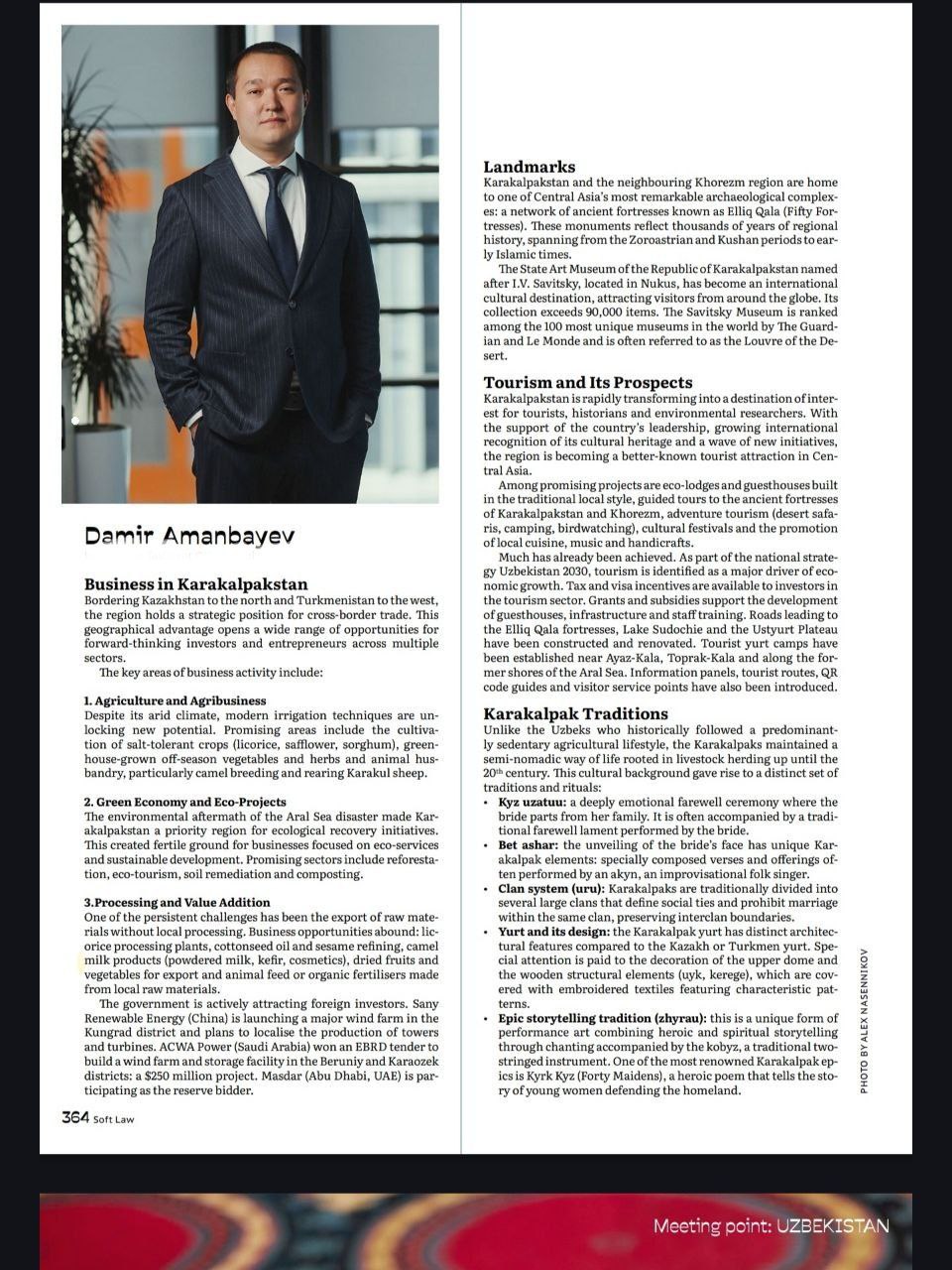
Damir Amanbaev
Managing partner